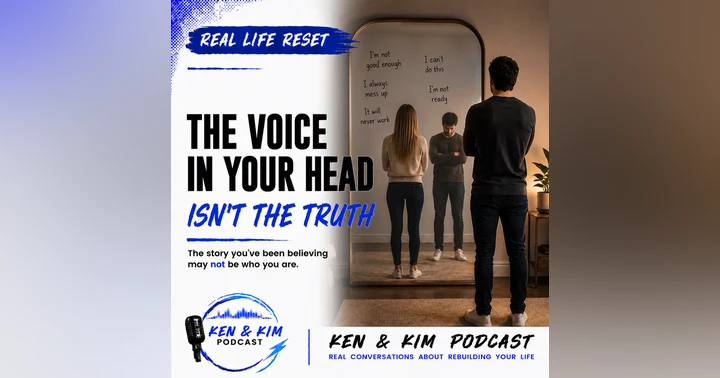
The Voice in Your Head Isn't Always Telling the Truth - EP 23


What if the thing keeping you stuck isn't your circumstances—but the story you've accepted about those circumstances? Most of us have an inner voice that constantly narrates our lives. It tells us we're not good enough, not capable enough, too late, too broken, or destined to repeat the same mistakes. The problem is that after hearing those thoughts long enough, we stop questioning them. We start believing them. In this episode, we explore one of the biggest breakthroughs in personal growth: ...
What if the thing keeping you stuck isn't your circumstances—but the story you've accepted about those circumstances?
Most of us have an inner voice that constantly narrates our lives. It tells us we're not good enough, not capable enough, too late, too broken, or destined to repeat the same mistakes. The problem is that after hearing those thoughts long enough, we stop questioning them. We start believing them.
In this episode, we explore one of the biggest breakthroughs in personal growth: realizing that you don't have to believe every thought you think.
We talk about:
• How thoughts become beliefs and beliefs become identity
• Why most limiting stories begin with a single painful event
• The difference between pain and victim mentality
• How fear, failure, rejection, and disappointment can quietly shape your future
• Kim's powerful breakthrough that changed her relationship with depression forever
• Why rebuilding your life starts with rebuilding your identity
If you've ever felt stuck, trapped by your past, or limited by the stories you've been telling yourself, this conversation may completely change the way you see yourself.
Because sometimes the biggest thing standing between you and the life you want...
is a story you've been repeating for years.
Send a text message to the show!
If you like this episode please click like, share or join our community (The Rebuild Room group on Facebook) https://www.facebook.com/share/g/1XFkvp2E81/
Check our website for free tools and resources https://www.kenandkimpodcast.com/
The voice in your head isn't always telling the truth. One of the biggest breakthroughs in personal growth is realizing you don't have to believe every thought you think. Just because your mind says, you can't do this, doesn't make it true. Just because your mind says, this won't work doesn't make it true. What if the thing keeping you stuck isn't your circumstances? What if it's the story you've accepted about those circumstances? Maybe something happened years ago. Maybe you failed. Maybe someone hurt you. Maybe you got rejected. Maybe life didn't go the way you thought it would. And in that moment, a thought appeared. Maybe it sounded like I'm not good enough. I always mess things up. People always leave me. Nothing ever works out for me. At first it was just a thought. But then you repeated it. Then you believed it. Then you built an identity around it. And eventually that story became the lens through which you see your entire life. The scary part, most people never stop to question the story. They question themselves. They question their abilities. They question their dreams. But they never question the narrator. And one of the biggest breakthroughs we've had in our own personal growth journey is realizing this. The voice in your head isn't always telling the truth. And some of the stories you've been carrying for years may not be true either.
SPEAKER_04Today we're talking about something that affects every decision you make, every opportunity you pursue, every risk you avoid, every version of yourself you believe is possible. And that's the stories you tell yourself. Because most people don't consciously decide who they become. They slowly become the person their inner story says they are. And when that story is built from pain, fear, rejection, failure, or disappointment, it can quietly shape an entire life. This isn't an episode about positive thinking. It's not about pretending everything is okay. It's not about ignoring the reality. It's about learning to separate what happened to you from the story you've built around what happened to you. Because those are not the same thing. And sometimes the biggest thing standing between you and the life you want is the story you've been repeating for years. So let's talk about it.
SPEAKER_00I'm excited for today because this is actually one of my favorite topics to talk about. As you know, I have my own very personal, powerful story that I have been I that I repeated for years, most of my life, actually, and how I overcame that. So I'm excited to talk about it a little later in the episode. But first, I just wanted to kind of touch on how, you know, everybody has these internal stories that they tell themselves. And we don't even realize that we're operating from these stories. You know, things like, I'm not confident or I'm bad with money, I'm unlucky, I'm always behind, I'm not disciplined, stuff like that. These are these statements that we tell ourselves, they feel like facts, right?
SPEAKER_04Yeah. People don't even question it. They just think that that's their life.
SPEAKER_00Right. But they're usually just interpretations. And at some point in their life, those thoughts became their beliefs.
SPEAKER_03Right.
SPEAKER_00And then that belief became their identity.
SPEAKER_03Yep.
SPEAKER_00You and I know this firsthand. We've obviously done this. Like the person who's always saying, like, oh, I'm bad with money. Right. And that's just like the identity that they take on.
SPEAKER_03Right.
SPEAKER_00And they live within that identity. They live their life thinking they're just bad with money. When the fact of the matter is, they might not be bad with money at all. It could just be like they had instances in their life where they were bad with money.
SPEAKER_04Yep.
SPEAKER_00They made a mistake.
SPEAKER_04And they operate just based on that belief.
SPEAKER_00They made a mistake with money. They got into some credit card debt and didn't pay off the credit cards. And then their credit score went to shit. And that happened in their 20s. And then they got into this big financial situation and they have to file bankruptcy. And now they live with that story, like, yeah, I'm really bad with money, because you know, maybe their parents had to help help them out or something like that. And their parents were like, You're really bad with money. And they're like, Yeah, yeah, I'm bad with money. And that's the identity that they take on. And so now they're living from that place of I'm bad with money. When in fact, maybe they're not bad with money and they just need to create their new identity.
SPEAKER_04Right. And it's funny, Kim, because uh in the past I heard now that you're talking about money, so they believe they're bad with money. They think, you know, that that's their life. And to the point that when they have to pay the credit cards, they even think that it's okay to pay the fee that the bank is charging them because they're not paying the full statement. And they're like, well, you know, I didn't pay the whole thing. You know, it's okay if the bank I heard it in the past.
SPEAKER_03Yeah.
SPEAKER_04Oh, well, the bank is charging me 20 bucks in interest.
SPEAKER_03Well Yeah, I know.
SPEAKER_04And it's just okay.
SPEAKER_03Yeah.
SPEAKER_04Are you okay with the bank really you know, charging you that kind of money when you could just do something different? Different, right? You're just acting, you're just letting it be, well, I'm not good with money, and I know I'm spending the money right now, and I just not really planning how to pay it after. It's some sort of identity that you that you have, right? That you how you're paying your bills, how you were spending money. And all that happened at some point, like you were saying, earlier in life.
SPEAKER_00And most of us don't even remember where those stories came from. Right? That's a that's an obvious one, sort of obvious. I mean, it's not obvious to the person living it, but like, you know, a lot of these stories come from early childhood. Somebody says something to you, like, oh, you're, you know, if you're always clumsy. You're you're so clumsy, you're always getting hurt. You're such a clumsy kid, you know. And you hear that over and over in your childhood, and then so you take that into adulthood and you're like, yeah, I just always get hurt. And then you believe that, and then the these stories that you tell yourself just become the truth, and they just become your identity.
SPEAKER_04One event, one moment, one painful experience, and that's basically it. And suddenly a story gets written, right? I failed becomes I am a failure. I was rejected, becomes I'm unwanted.
SPEAKER_00Yeah, most identities begin as stories and not as facts. But once that story gets repeated long enough, the problem isn't the event that happened. The problem is that you take on that role. You take on that identity and you claim it as your own, and that's where the place that you live your life from. That's the problem. And it's like, who gave you that role and why are we still carrying it? You know, why do we carry those identities? Why can't we just like hear the thing that people say about us or whatever instead of living from that place?
SPEAKER_04But Kim, like you said, but once that story gets repeated long enough, it becomes your identity. You don't even notice it. And then you you wonder why you have bad luck, or again, why are you bad with money? You feel like you're the victim. We all knew at some point someone that talked about, like, oh, well, you know, it's my bad luck, or that's how it is, or Well, it's like when we had the businesses, right?
SPEAKER_00And they they eventually f failed. We had to sell them at a loss, right? We could have carried that identity, like, oh, we suck at business, we're just no good at it, we can't we can't run a business, right? We could have just carried that that identity when we're moving across the country, but instead we were like, no, we're not gonna accept that identity and choose that role in our life. We're going to change it.
SPEAKER_04Right. So we didn't let that failure be define us.
SPEAKER_00We chose a different identity, which was like, no, we like to be business owners and we're gonna try again. Right. Yeah. Regardless of the failure that we had.
SPEAKER_04Yeah. We closed the chapter.
SPEAKER_00Decided to rebuild. Whereas a lot of people would have said, Oh no, business, don't do that. I had this one, these two restaurants, and they failed. And that's the story we could have been telling people, right? We could have been working jobs right now and saying, No, no, no, no, no, man, don't go into business. Yeah. It's not for the faint of heart. It's really hard. And, you know, you could fail and you could lose a lot of money. And, you know, we could have told that story. Instead, we chose a new identity and we're like, nope, we're gonna just pick ourselves up and try again.
SPEAKER_04So we knew that wasn't a reality, right? Or our identity. Like, oh, well, we just failed and now let's go get jobs, just settle, and that's about it. Like, no, we knew you know what? The business didn't work out, we sold it at a loss, we moved on, and we didn't allow that failure to shape our identity.
SPEAKER_00Right. The unfortunate part about it is a lot of people don't do that, right? Yeah. People don't act based on reality, they act based on this identity that they have taken on. So the problem isn't the event, the problem is becoming the role. When you take on that role of being the victim or the failure, or the person who's not good at relationships, or the people pleaser, or the anxious person. Who gave you that role? And why are you still carrying it? It's like the person who goes through a nasty divorce, right? And they spend years battling their ex-wife or ex-husband in court, and now they're left with nothing. They got no relationship, no money, no house, whatever. Their kids are taken away, whatever the heck happened. But they they take on this identity of I suck at relationships. I can't make this work, right? They didn't want the divorce, but the the wife wanted the divorce, and now the husband's stuck at home in a one-bedroom apartment, sad, no money, lonely. And he's thinking, man, I couldn't, I I couldn't make my wife happy. I sucked at the that relationship. I allowed it to fail. I didn't do everything I could do to save it. And now here I am. I just suck at relationships.
SPEAKER_03Right.
SPEAKER_00And his buddies are like, no, bro, let's go out. Let's meet some new people. Let's go do this or do that. And the guy's like, no, I don't want to meet anybody new. I suck at relationships. I'm not even gonna try.
SPEAKER_04Yeah. Yeah. It just gets wounded so deep that it becomes an identity.
SPEAKER_00Right.
SPEAKER_04That he doesn't want to carry, but he doesn't even know how to shake it off.
SPEAKER_00Right. It's just a role that this person has accepted now as their identity, and they are allowing it to direct their life.
SPEAKER_04Yeah. So one event changed everything.
SPEAKER_00And then that's where this starts costing us more than we actually realize because now it's controlling our future. Right. Our current, our present and our future, that identity of a story that likely is not even true. Right. So he's like, one bad relationship he's allowing to control his present and his future.
SPEAKER_04Yeah. And I see it sometimes in social media, like, oh, I went through this nasty divorce, whatever, and I'm so afraid to date again.
SPEAKER_03Right.
SPEAKER_04I'm afraid to open my heart. You know, I don't even want to do it.
SPEAKER_03Yeah.
SPEAKER_04They're stuck at home, they're confused, and I get it. I can only imagine. It's not easy, right?
SPEAKER_03Yeah.
SPEAKER_04But you have to move on. Again, we're just kind of discussing here how deep an identity could be embedded in you to the point that you just feel like paralyzed. And now you're acting, like you said, Kim, everything that you do is based on that event or in that you you took that identity too deep that now it's gonna, you know, it turns into like a it's your life now.
SPEAKER_00Yeah, it's shaping everything.
SPEAKER_04Right. So, but again, that that's not the reality. You mentioned it earlier, Kim, that people don't act based on reality, they act based on identity.
SPEAKER_00Yeah, think about it. Like that person is acting based on this identity. He's identifying with this person who's no good at relationships, but that's not reality. So he's he's acting based on this identity that he has embodied. He's allowed it to be true in his mind, right? Right.
SPEAKER_04Yeah, yeah, Kim. So the story creates behavior, the behavior creates results, and the results reinforce the story.
SPEAKER_00Exactly. You don't see life as it is, you see life through this story that you've accepted. And this is why some people stay stuck for decades. Like for me, for example. And this is the powerful story that I love sharing with everyone. And I know I've shared it before, but I think it's worth repeating because I think it's a good one. One of the most transformational moments in my life was when I realized that the voice in my head isn't always telling me the truth, and that I actually had control over it. And that event was at Mind Valley, as you know, in Miami. And they had several speakers there, and I don't remember exactly which one. Um, I think her name was Caitlin, and she was like the host of the show. I think there there were several things that happened that weekend, but I think part of her story was how that we could choose to not listen to the story that's running in our head.
SPEAKER_03Right.
SPEAKER_00And that was the most powerful moment for me because I was it made me realize like, oh, the I don't have to listen to that voice in my head. I don't have to believe what it's telling me.
SPEAKER_02Right.
SPEAKER_00Cause up until that point, I always had, right? I've always listened to what the voice is telling me. I just thought like this is who I am and whatever it says is truth for me.
SPEAKER_02Right.
SPEAKER_00And then I realized in that moment, you know, that was my story of depression that I had been telling myself for decades didn't have to be true. It didn't have to be the identity that I took on, right? Exactly. I took on that role because when I was younger, I had severe depression because of, you know, events and small traumas in my life that I had, right? And I allowed myself to become depressed and anxious, and I internalized all that pain in a way that was really unhealthy.
SPEAKER_04Okay. Yeah. Well, before you continue, okay. Um, I'm pretty sure a lot of people don't know the story in depth, even though we talked about it in previous episodes.
SPEAKER_00Yes. It it's it's how you internalize the story, right? So I realized in that moment, sitting in Mine Valley three years ago now, I think.
SPEAKER_03Yeah.
SPEAKER_00Um, at that event, I realized that the way I internalized that pain, I was becoming, I, I became a victim of that story. Yeah. And I realized that I didn't have to. And that was the most powerful moment for me. It didn't mean that I didn't spend years suffering. I did. I spent years suffering. It was very painful. I was suicidal. I was cutting myself from a young age. I was just in the depths of depression for so very long. And I fought really hard to get out of it.
SPEAKER_03Yeah.
SPEAKER_00It was a terrible, terrible place to be. When I realized that I didn't have to take on that identity any longer, it was like a weight lifted. Yeah. And something inside me shifted. Right. And it was from this woman's simple words of telling her story. And that's kind of what drives me and makes me so passionate about telling my story because I just know the impact that someone's words can have on you. And so if I can bestow that upon anybody else, then that completes a piece of my soul.
SPEAKER_04Right. I remember that the weekend you were so excited right after the event. Uh you have this kind of awakening realization of like, wait a minute.
SPEAKER_02Right.
SPEAKER_04You know, like I've been handling my life wrong. Like my thoughts, they've been wrong the whole time.
SPEAKER_00And they've been They've been controlling me.
SPEAKER_04They've been running behind the scenes the whole time.
SPEAKER_00Right.
SPEAKER_04And this is really hard for for people to see. Right. Because you just go with your emotions.
SPEAKER_03Correct.
SPEAKER_04Let's say you get up tomorrow morning, right? And then you're feeling sad. You're feeling depressed. But you don't know why. You're just upset and sad. Right? It could be financials, could be health problems, marital. Yeah. Friendships. A lot of things. But those do not actually define who you are. But we allow it. We get up in the morning, we see the bank statement is low. That's how you start your day.
SPEAKER_03Yeah.
SPEAKER_04And it's upsetting. It seems like you have no control.
SPEAKER_03Right.
SPEAKER_04And you get depressed, you get upset. And then or maybe your husband is not treating you right. Or your family, your mom, or your your siblings, whatever. And you're kind of building all this up. Right? So you're letting you letting the events build an identity that is not real. Well, you're living it, you you may think like, oh, it is real. Yeah, but those events are not defining who you are. You need to find a way to escape those. That's what you did when we went to Mind Valley in Miami when we saw it from a different perspective, like, hey, wait a minute, that's not who I am. I have to do something. You started doing, reading all the books, and he started kind of doing all the work to get out of it. So you won't get out of it right away. But once you acknowledge that there is a problem, that there is an issue with your identity, what's actually shaping your daily life, things will start changing.
SPEAKER_00Yeah. Well, so in my case, you know, I had this voice in my head telling me my whole life, like, you have depression, like it's okay. Like, this is just who you are, you know. You just have to take your medication, you just have to seek out different treatment options. And this is just the the cards that you've been dealt. Yeah. Right. And that is the story that I lived by. I was like, well, you know, it runs in my family. It's a chemical imbalance. And this is just my life. This is just what I have to accept. I have to work hard to not be depressed. I have to take alternate methods that other people don't have to deal with. And this is just life. And that's what the voice in my head was telling me. That is the story that I was telling myself. That is the identity that I built my life around. Yeah.
SPEAKER_04And I saw it too, Kim. You know, again, this is really hard for a lot of people to see like, no, no, that's not it. I'm just, it's a chemical imbalance that I have. Right. And it could be, yes. You know, we're not saying that it's not. The mind, the brain is a mysterious thing.
SPEAKER_00Well, when you start looking into the science of it, you can you are capable of creating the chemicals that will change all of that for you. And which is how I was able to come off of all the medications and not seek further treatment or therapies or anything like that is because I started changing the chemicals within my brain. Slowly. Yeah. Yeah. With a new approach.
SPEAKER_04Yeah. One of the things, once you acknowledge that there is an issue and that you want to change.
SPEAKER_00Yeah. Then it's just putting in the work.
SPEAKER_04Yeah. And then you have the power. You get the I am now powerful. I am now better. I am now.
SPEAKER_00Which honestly, in that event, I felt powerful. I felt really powerful and I felt excited. I felt I felt sad. I felt a little bit of sadness because I I saw the the price that I paid for accepting that identity for so long. I saw all the missed opportunities. I saw all of the things that I missed in my life and the forward momentum that I could have been making because I allowed myself to live from that place. Yeah. That victim mentality of not being in control of my life.
SPEAKER_04Yeah. We are the problem and the solution. We talked about this in a different episode. Right. And it's really hard to see, but it is true. At that moment, the chains were broken.
SPEAKER_00Right. And then, and once you see it, you can't unsee it. Once you comprehend that this voice in your head that is telling you these stories and reinforcing this identity, once you hear that voice and understand that it's not true and it is a choice that you're making, you can't unsee it. And you're just like mind-blown, right? What's the emoji with the brains that are blowing up in the cloud? Because there it's just like a mind-blowing moment. And that's what I had there. And there were so many emotions mixed in with that. But it was just such an exciting moment for me because that was the ultimate turning point in my life.
SPEAKER_03Right.
SPEAKER_00Where I started, I just made a decision that day, that weekend. I made a commitment that I was going to rebuild my identity from there and I was just going to reinvent myself. Yeah. And that was it.
SPEAKER_04Yeah, you basically applied the Henry Ford famous quote either if you think you can or you cannot, you are right.
SPEAKER_00Right. Yes. Exactly. And that's ultimately what has started me on this feverish path of rebuilding my life.
SPEAKER_03Right.
SPEAKER_00Rebuilding my identity and just re reinventing myself, creating a new version.
SPEAKER_04But Kim, sometimes we need the failure stories. We need the victim story, the rejection story, in order for us to rebuild ourselves.
SPEAKER_00Oh, a hundred percent. I agree with that. Because again, I wouldn't choose any other way. Like I wouldn't have chosen a different path in my life or a different life. As much as I could say, yeah, it would be so much easier, right? My life would have been so much easier, but I don't think my life would have been as fulfilling if I didn't live through all of that, of those years, decades of suffering. And I'm not saying that like life is about suffering and we have to go through suffering, but like you do have to go through pain to kind of reinvent yourself. Right. You have to learn how to persevere and push through and change. And you come out the other side like this stronger, more powerful version of yourself.
SPEAKER_04Right.
SPEAKER_00So I wouldn't change any of that.
SPEAKER_04So you didn't let pain convince you that that's who you were.
SPEAKER_00Right. And that stands true through my whole for my whole life. Like I didn't just sit back and like, oh, I'm depressed. And you know, that's just me. I was fighting so hard for so long. For so long. I was trying a million different things to get rid of it. But the one piece that I was missing hit me in that seminar. The one piece that is necessary was the simple decision to understand that that was the story that my the voice in my head was telling me. Right. Changed everything.
SPEAKER_04Exactly.
SPEAKER_00It was that single piece that I heard that weekend, which was you are making a choice by listening to that voice in your head.
SPEAKER_04And again, the goal isn't positive thinking. Because I know people may think that, oh yeah, well, you just have to think positive, blah, blah, blah. The goal is questioning the story. You know, is this actually true? What whatever is happening in your life? Is this always true?
SPEAKER_00Yeah, absolutely. I I agree with you because to my point, like that I was saying, is I that's when I was sort of questioning the story. That was the pivotal moment. Exactly. The moment you question the story is when you're creating space for a new identity. And that's where the rebuilding begins. And that's the fun part, honestly. That that's been the most satisfying part ever since that event has been rebuilding my life and creating this new identity, reinventing myself.
SPEAKER_04That's right. Very powerful.
SPEAKER_00You don't rebuild your entire life first. You have to rebuild the identity that's creating your life. And this is the reinvention of yourself part, right? You're going from a place of being a victim to becoming a creator. You're going from powerless to responsible, fearful to willing, broken to healing, stuck to growing. I was stuck and I was a victim, right? But once I gained that power, that one through that one piece of knowledge, I started reinventing myself one piece at a time.
SPEAKER_04Exactly.
SPEAKER_00And it wasn't done overnight.
SPEAKER_04Yeah. You said from victim to creator, and that would be like, all right, if I'm not a depressed person, how can I when you're depressed, you know, you feel like everything sucks.
SPEAKER_03Yeah.
SPEAKER_04Right. And like you said, in some cases, depression is so bad that you just feel suicidal. You just want to end it.
SPEAKER_03Yeah.
SPEAKER_04Right. So how can you be a victim or a depressed or a victim slash depressed person via creator?
SPEAKER_00Well, I feel like for me, anyways, through my experience, when I was depressed, I of course had these moments or these time periods of, you know, excitement where I was looking forward to this. And something fueled a different emotion other than just strictly depression. Yeah. Although that was always running in the background, I did have these moments of clarity. So from that weekend on, I was just excited and I became this creator.
SPEAKER_04And I believe it.
SPEAKER_00And we're all creators anyway. I believe it.
SPEAKER_04So you you're creating a new identity, a new persona. You created a new for whoever is listening out there, and if you're depressed, the victim, like you said, Kim, victim slash depression to be a creator. You created this new persona. This person now that was excited to read the books. Yeah. Excited to make changes.
SPEAKER_02Right.
SPEAKER_04Excited to build a business. Excited to help people. Right? Exactly. So you created tons of rebuild guys that we have on our website. You got your life coaching certification to help others. Yeah. So when you go from a victim or a depressed person, when you broke the chains in you don't even realize it then now that you're a creator.
SPEAKER_00Yeah.
SPEAKER_04You started creating things.
SPEAKER_00Well, that's the exciting part because you literally, those are the things that excite me, right? Those are what fuel me and light me up. But for somebody else, it might be like, I want to be a nurse or I want to be a whatever, a lawyer, doctor, whatever.
SPEAKER_04An artist, and then you have like these amazing paintings, right? And then from just let's just give an example again. Like just imagine that you're having this awesome paintings, right, at home and you're just depressed. But now once you break the chains like you did, Kim, now you start thinking like, well, I can I can start selling them, putting them in a gallery, or donate them. I'm gonna put them. Yeah, you're thinking.
SPEAKER_00Now you're thinking, well, I'm not a depressed person, I'm an artist. And you embrace the exciting part of you now. You're like, oh, I am an artist. And then you're like, well, let me take some classes and let me get better at my chosen path.
SPEAKER_03Yeah.
SPEAKER_00Well, whatever that looks like for anybody, you know, but that's the exciting part, is that now you're the creator, you're in control of this voice in your head. And when that voice creeps in, now you know you can shut it down.
SPEAKER_04You can shut it down. Yeah.
SPEAKER_00And you can change direction, you can pivot, you can do whatever you want with it. Because it's literally not in control. Like you control it. And that moment is the exciting part. You just start rebuilding, creating this new identity.
SPEAKER_04Yeah, yeah. It's a lot of work. Again, I I can only imagine people hearing this, like, oh, yeah, well, it's not easy. You're not depressed anymore, or what kind of depression you had, because yeah, I can barely put the radio on in the morning when I just want to cry in my car or I'm always depressed at home and nothing's working out. Yeah, well, I you're still trapped. If you're feeling that way, you haven't break the chains.
SPEAKER_00Right. Yeah. So if you're coming from a place of feeling broken, now you get to move into a place of healing. Or if you're coming from a place of being stuck, now you can be the person who grows, right? Because I was stuck, but now I choose to grow. Every single day I wake up, I choose to heal myself and I choose growth over being stagnant.
SPEAKER_03Right.
SPEAKER_00The future version of you cannot be built from the same story that created your current life. So the key is to reinvent yourself. Start building your story page by page. Define who you want to become. Define what fuels you, define what lights you up. Start making notes. Create the new version of yourself that you want to become and start doing it. Most importantly, you have to start doing it.
SPEAKER_02Right.
SPEAKER_00Start taking the necessary steps to start building this new identity, whatever that looks like for you. Some of the stories you've been carrying for years may have started as pain, but that doesn't mean they need to become your identity. You are not your worst moment, and you're not your biggest mistake, and you're not the story that fear keeps repeating. The most powerful thing you can do is question the story, because the moment you do, rebuilding becomes possible. Some powerful reflection questions that you can ask yourself while you're on this journey of rebuilding your identity? What story about yourself have you been treating as a fact? And where did that story come from? Is it actually true or has it simply been repeated?
SPEAKER_04Right. And what role have you accepted that no longer serves you? Are you carrying pain or an identity built around your pain? What would change if you stopped introducing yourself through your wounds?
SPEAKER_00If this episode resonated with you or helped you in any way, we'd love for you to share it with someone who needs to hear it. And if you're ready to go deeper, we created something for you. Head over to Ken and Kimp Podcast.com where you can get access to our full library of rebuild guides. These are step-by-step tools designed to help you actually apply what we talk about here. And if you want to connect with us, join our private Facebook community, the Rebuild Room, where we're having real conversations about rebuilding your life. We'll see you in the next episode.